How to Burn a Scented Candle: First Burn, Wick Care and Why Candles Tunnel
A scented candle seems like the simplest thing in your home: light it and you're done. But the way you burn it determines whether the fragrance fully opens up, how long the candle lasts, and whether it ends up half-full with a deep hole in the middle.
In this article, we explain how to burn a candle properly from the first burn to the last: how long to keep it lit, how to care for the wick, why a candle tunnels or produces soot, and what to do about it.
The first burn: the most important step
To keep your candle from tunneling, let the wax melt across the entire surface, all the way to the edges of the jar, during the first burn. For to be candles, this takes about 3–4 hours.
Why candles tunnel
Wax has a "memory". If you put the candle out after 20–30 minutes the first time, when only a small circle around the wick has melted, it will only melt within that circle from then on. This creates a hole, or tunnel: the wick sinks deeper and deeper, while wax that will never burn is left on the sides.
A tunneled candle has a weaker scent throw, because only part of the wax melts. It burns for a shorter time, and towards the end the flame may start going out for lack of air.
How to do the first burn
- Choose an evening when you'll be home for at least 3–4 hours.
- Trim the wick to 5 mm (about 1/4 inch).
- Place the candle on a flat, heat-resistant surface, away from drafts.
- Light the candle and don't put it out until the top layer of wax is completely liquid from edge to edge.
Follow the same rule every time after that: let the candle burn long enough for the wax to melt all or almost all the way to the edges.
How to care for the wick
Trim the wick to 5 mm before every burn. A long wick produces a tall, uneven flame that makes the candle smoke and leaves black soot on the sides of the jar. A wick that is too short barely burns and can't melt the wax.
- What to trim it with. Nail scissors or a special wick trimmer work well. A wooden wick can simply be snapped off gently with your fingers.
- When to trim it. Only when the candle is cold and the wax has set.
- What to do with the trimmings. Remove them from the wax surface. Bits of wick left in the candle can catch fire and create a second flame.
Why a wooden wick crackles
A soft crackling sound, like a fireplace, is perfectly normal. Wood has a natural structure, and as it burns, the wax and air in its fibres heat up and make this sound. That's exactly why many people choose wooden wicks: they create a special cosy atmosphere.
If a wooden wick goes out or barely burns, it most likely has carbon build-up or is too long. Wait until the candle cools down, gently remove the charred part and trim the wick to 5 mm.
How long to burn a candle at a time
Ideally, between 1 and 4 hours in a row. Less than an hour, and the wax doesn't have time to melt to the edges. More than 4 hours, and the wick grows long and mushroom-shaped, the flame gets bigger, and both the candle and the jar overheat. If you want to enjoy the fragrance longer, put the candle out, let it cool, trim the wick and light it again.
Stop burning the candle when about 1 cm (just under 1/2 inch) of wax is left at the bottom. This keeps the bottom of the jar from overheating.
How to put out a candle properly
Blowing out a candle sends up smoke and a burnt smell that overpowers the fragrance. Sometimes wax splatters onto the table. It's better to put out a candle in one of three ways:
- A candle snuffer. Cover the flame with it for a few seconds.
- The jar lid. If there is one, gently cover the candle: without oxygen, the flame will go out on its own.
- Tweezers or a stick. Dip the wick into the melted wax and straighten it right away. The flame goes out without smoke, and the wick stays coated in wax, so it lights easily next time.
Never put out a candle with water: it splatters hot wax and can crack the glass jar.
Why a candle smokes, goes out or barely smells: common problems
The candle is tunneling
Cause: the first burn was too short.
What to do: burn the candle longer, until the wax melts to the edges. If the tunnel is deep, wrap foil around the rim of the jar, leaving an opening above the wick: the heat will melt the wax along the sides.
The candle smokes and the jar turns black
Cause: the wick is too long, or there is a draft.
What to do: trim the wick to 5 mm and move the candle away from windows, air conditioners or doors.
The flame is too tall and uneven
Cause: the wick is too long, or the candle has been burning for more than 4 hours.
What to do: put the candle out, let it cool and trim the wick.
The candle keeps going out
Cause: the wick is too short, has carbon build-up, or the tunnel is too deep.
What to do: remove the carbon build-up. If the wick is drowning in wax, carefully soak up a little of the liquid wax around it with a paper towel.
The scent is barely noticeable
Cause: the wax only melts around the wick, or the room is too large.
What to do: let the candle burn for at least an hour so an even layer of melted wax forms. In large rooms, close the doors.
Soy vs paraffin candles: what's the difference
The burning rules are the same for any candle, but soy wax behaves a little differently.
- Origin. Soy wax is plant-based and made from soybean oil. Paraffin is a by-product of petroleum refining.
- Melting point. Soy wax melts at a lower temperature, so the candle burns more slowly and evenly. That's also why a long first burn matters so much for soy candles.
- Scent. A soy candle releases its fragrance softly and gradually as the wax melts. So during the first 15–20 minutes, the scent may be barely noticeable — that's normal.
- Surface after cooling. Soy wax sometimes develops an uneven surface or a white coating. This is a natural property of plant wax, not a defect, and it doesn't affect how the candle burns or smells.
All to be candles are made from soy wax, either white or black.
Safety: rules you should never break
- Never leave a burning candle unattended or fall asleep while it's lit.
- Place the candle on a flat, heat-resistant surface, away from curtains, books and fabrics.
- Keep the candle out of reach of children and pets.
- Don't move the candle while the wax is liquid: the jar is hot and the wax spills easily.
- Air the room after burning a candle, but don't place it in a draft while it's lit.
Which candle scent to choose
It's best to choose a scent to suit your mood and the occasion. Here's how to be scented candles are grouped.
For warm autumn and winter evenings
- SWEET WOOD — white musk, patchouli and cedar. A soft, cosy scent for relaxing in the evening.
- SANDAL WOOD in a gift box — sandalwood, cedar, tobacco and oriental notes, with a wooden wick.
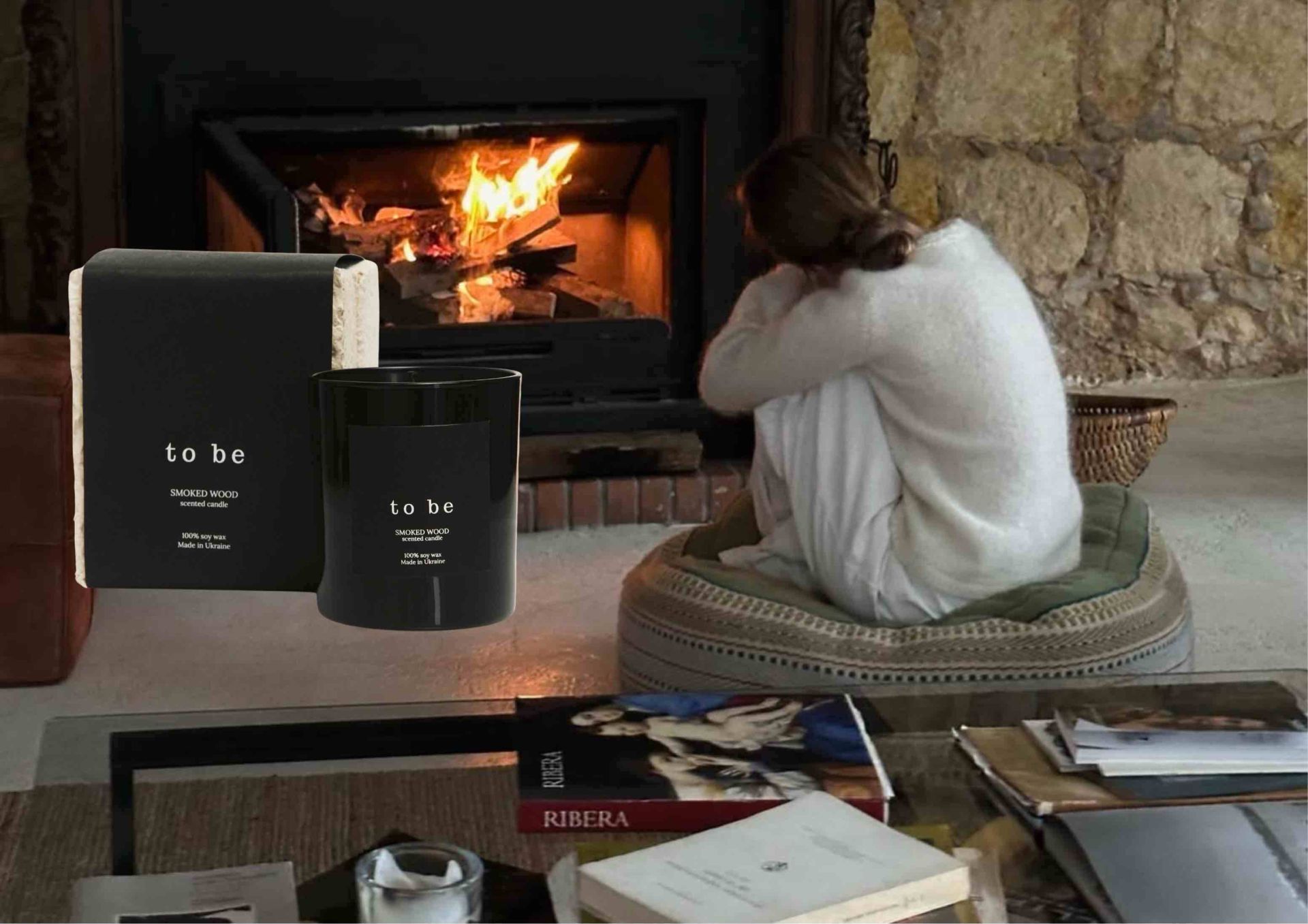
- SMOKED WOOD — sandalwood, cedar, oud, flowers and pepper. A deep, smoky scent for cold evenings.
- WOODY AMBER & SMOKED WOOD candle set — two 75 ml candles in a gift box. WOODY AMBER combines woody amber, jasmine, lemon and moss. A great way to try two scents at once.
For calm and focus
- PALO SANTO — the woody scent of palo santo, the "holy wood" associated with harmony and calm. A good fit for meditation, yoga or a quiet evening.
- STAY FOCUSED — a scent created for a productive mood. It helps you concentrate, so it suits a home office.
In a gift box
- SWEET HOME and COZY EVENING — white soy wax candles, ready to give as a gift.
- SWEET WOOD, PALO SANTO and STAY FOCUSED are also available in gift boxes.
You'll find all the scents in the to be scented candles catalogue. And to learn how scents affect your mood, read our article "How scent affects your emotional state".
How to burn a candle: the essentials
To make your candle burn evenly and fill your home with fragrance down to the last centimetre, you only need three habits: a long first burn to the edges of the jar, a 5 mm wick before every burn, and no more than 4 hours of burning at a time. The candle will take care of the rest.
Share the publication: